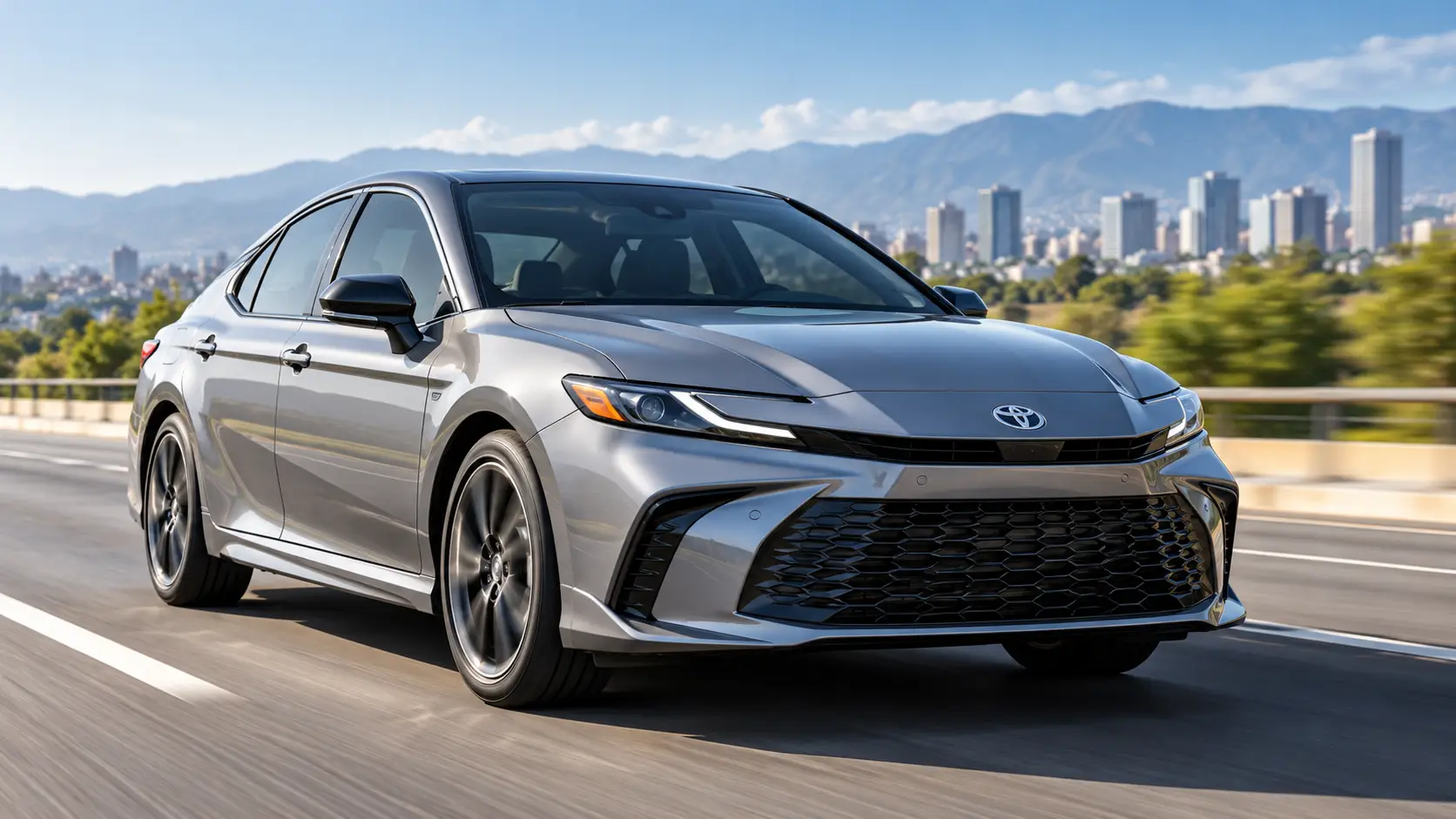
The 2025 Toyota Camry Hybrid brings a big change to one of America’s best-known sedans. For the first time, every Camry sold in the United States for the 2025 model year comes with a hybrid engine. That means better fuel economy is no longer limited to a separate hybrid version.
The redesigned Camry also gets a sharper exterior, updated technology, more standard safety features, and available all-wheel drive on every trim. It delivers up to 51 MPG combined, making it an appealing choice for drivers who want to spend less on gas without switching to a fully electric vehicle.
But is the 2025 Camry Hybrid worth buying? And should you choose the affordable LE, sporty SE, comfortable XLE, or premium XSE?
Let’s look at the real differences, including prices, fuel economy, performance, interior features, and what you should know before buying one.
2025 Toyota Camry Hybrid at a Glance
| Specification | 2025 Toyota Camry Hybrid |
|---|---|
| Vehicle type | Midsize hybrid sedan |
| Engine | 2.5-liter four-cylinder hybrid |
| Horsepower | 225 hp FWD / 232 hp AWD |
| Transmission | Electronic continuously variable transmission (eCVT) |
| Drivetrain | Front-wheel drive or available AWD |
| Fuel economy | Up to 51 MPG combined |
| Seating | 5 passengers |
| Cargo capacity | 15.1 cubic feet |
| Fuel tank | 13 gallons |
| Available trims | LE, SE, XLE, XSE |
| Original starting MSRP | $28,400 |
| Hybrid battery warranty | 10 years / 150,000 miles |
The Camry is a regular hybrid, not a plug-in hybrid. You simply fill the tank with gasoline as usual. The electric motor and battery work automatically while driving, with regenerative braking helping recharge the battery.
This makes the Camry especially convenient for people who want better gas mileage but don’t want to install a charger or plan their trips around charging stations.
What’s New in the 2025 Toyota Camry Hybrid?
The 2025 Camry starts the model’s ninth generation in the United States. Toyota made more than a few styling changes.
Every Camry Now Has a Hybrid Engine
Previous Camry generations offered conventional gasoline engines alongside hybrid versions. For 2025, Toyota removed the gas-only choices from the US lineup.
Every LE, SE, XLE, and XSE uses Toyota’s fifth-generation hybrid system paired with a 2.5-liter four-cylinder engine.
You no longer need to buy a special hybrid trim to get the fuel-saving benefits.
All-Wheel Drive Is Available Across the Lineup
The 2025 Camry is also notable for offering AWD with its hybrid powertrain.
Drivers can choose front-wheel drive for maximum efficiency or all-wheel drive for additional traction in rain, snow, and slippery conditions.
The AWD system uses an electric motor to power the rear wheels when extra traction is needed. It works automatically, without requiring the driver to change gears or manually engage four-wheel drive.
A Fresh Exterior and Updated Cabin
Toyota redesigned the front end with slim headlights, distinctive LED lighting, and a wider-looking grille.
Inside, the Camry features a modern dashboard, improved infotainment technology, wireless smartphone connectivity, and a more polished layout.
The biggest change is that the car now feels more contemporary without losing the straightforward controls that many Camry buyers appreciate.
2025 Toyota Camry Hybrid Price by Trim
The 2025 Camry Hybrid originally launched in the United States with a starting MSRP of $28,400 before delivery and other fees.
Toyota’s later model-year listings showed a $28,700 starting MSRP. This difference reflects published pricing at different points, not a separate generation of the car.
Here are the original launch prices for all four trims.
| Trim | FWD Starting MSRP | AWD Starting MSRP |
|---|---|---|
| Camry LE | $28,400 | $29,925 |
| Camry SE | $30,700 | $32,225 |
| Camry XLE | $33,400 | $34,925 |
| Camry XSE | $34,600 | $36,125 |
These are original US launch MSRPs, excluding Toyota’s $1,095 delivery, processing, and handling fee, taxes, registration, dealer charges, and optional equipment. AWD added $1,525. Toyota subsequently published higher prices, and current used-car prices vary.
Since the 2025 Camry is now an older model year, many shoppers will find it through used-car dealers, certified pre-owned inventory, or private sellers.
When comparing prices, pay attention to mileage, accident history, trim, condition, and warranty coverage rather than relying only on the original MSRP.
Which Camry Hybrid Trim Offers the Best Value?
For most everyday drivers, the Camry LE is the strongest choice if fuel savings and a lower purchase price are the priorities.
The SE is worth considering if you like a sportier appearance, larger wheels, and a more responsive suspension feel.
The XLE makes more sense for buyers who want a more comfortable, upscale interior without choosing the sportiest design.
The XSE combines premium features with the sharpest styling, but it also costs more and has the lowest AWD fuel-economy rating in the lineup.
2025 Toyota Camry Hybrid MPG and Fuel Economy
Fuel economy is one of the biggest reasons to consider this car.
The 2025 Camry Hybrid can return up to 51 MPG combined, depending on the trim and drivetrain. That’s impressive for a midsize sedan with enough room for five passengers.
However, not every Camry Hybrid gets the same mileage.
MPG Comparison by Trim
| Trim | City MPG | Highway MPG | Combined MPG |
|---|---|---|---|
| LE FWD | 53 | 50 | 51 |
| LE AWD | 51 | 49 | 50 |
| SE FWD | 48 | 47 | 47 |
| SE AWD | 46 | 46 | 46 |
| XLE FWD | 48 | 47 | 47 |
| XLE AWD | 46 | 46 | 46 |
| XSE FWD | 48 | 47 | 47 |
| XSE AWD | 44 | 43 | 44 |
Toyota’s published trim specifications. Individual EPA listings and original brochure disclosures should be checked for exact certification details.
The LE FWD is the mileage leader. Its smaller 16-inch wheels and efficiency-focused configuration help it achieve better fuel economy than the sportier trims.
The XSE AWD returns less because its configuration includes larger wheels and additional drivetrain equipment.
Why Does the Camry Hybrid Get Better City MPG?
A hybrid vehicle can be especially efficient in city driving.
When you slow down, the Camry’s regenerative braking system captures some of the energy that would otherwise be lost as heat. It stores that energy in the hybrid battery for later use.
The electric motor can then help the engine during acceleration or power the car briefly at low speeds under suitable conditions.
This reduces how much gasoline the engine needs.
On the highway, the gasoline engine generally handles more of the work because the car travels at a steady speed. That’s why city MPG can be higher than highway MPG.
How Far Can a 2025 Camry Hybrid Travel on One Tank?
The Camry has a 13-gallon fuel tank.
Using its 51 MPG combined rating, the LE FWD has a theoretical full-tank range of approximately:
13 gallons × 51 MPG = 663 miles
Other versions have lower calculated ranges. For example, the XSE AWD’s 44 MPG rating gives a theoretical range of about 572 miles.
These are mathematical estimates, not guaranteed driving ranges. Actual mileage depends on temperature, speed, traffic, road conditions, tire pressure, and driving habits.
You also should not plan to use every gallon in the tank before refueling.
How Much Money Can the 2025 Camry Hybrid Save on Gas?
A car’s fuel economy becomes more meaningful when you translate MPG into dollars.
Imagine you drive 12,000 miles per year and pay an average of $3.50 per gallon.
Here’s how fuel expenses compare across different efficiency levels.
| Combined MPG | Gallons Per Year | Annual Fuel Cost |
|---|---|---|
| 30 MPG | 400 | $1,400 |
| 40 MPG | 300 | $1,050 |
| 47 MPG | 255 | $894 |
| 51 MPG | 235 | $824 |
Under these assumptions, the Camry LE FWD could save approximately $576 per year compared with a hypothetical 30-MPG gasoline car.
Over five years, that’s about $2,880 in fuel savings if annual mileage, fuel prices, and efficiency remain unchanged.
The difference between the LE FWD at 51 MPG and the SE FWD at 47 MPG is much smaller, at roughly $70 per year under the same conditions.
That leads to a useful buying point: if you prefer the SE’s appearance and driving feel, the fuel-cost difference alone may not justify choosing the LE.
Of course, the purchase-price difference still matters.
These calculations are examples, not predictions of future gasoline prices or actual vehicle expenses.
2025 Toyota Camry Hybrid Engine and Horsepower
The 2025 Camry Hybrid uses a 2.5-liter four-cylinder gasoline engine working with Toyota’s fifth-generation hybrid system.
The combined output changes slightly depending on whether you choose front-wheel drive or all-wheel drive.
| Powertrain | Combined Horsepower |
|---|---|
| 2.5L hybrid FWD | 225 hp |
| 2.5L hybrid AWD | 232 hp |
The AWD version makes an additional seven horsepower thanks to its rear electric motor.
Both versions use an electronically controlled continuously variable transmission, commonly called an eCVT.
Unlike a conventional automatic transmission that shifts through fixed gears, the hybrid system manages engine and motor power to provide smooth acceleration and efficient operation.
Is the 2025 Camry Hybrid Fast?
The Camry Hybrid has enough power for daily commuting, highway merging, and passing slower traffic.
Its electric motor helps deliver a quick response when accelerating from a stop, making the car feel lively during normal driving.
It isn’t designed to compete with sports sedans, but the available power should be more than adequate for most drivers.
In Clean Fleet Report’s published road test, a front-wheel-drive Camry XSE was described as responsive and easy to drive. The outlet reported a 0–60 MPH time of approximately 6.6 seconds.
Acceleration times can vary with vehicle configuration, road conditions, tires, and testing methods.
How Does the Camry Hybrid Feel on the Road?
The Camry focuses on making daily driving comfortable and predictable.
Its suspension is designed to handle uneven pavement without making the vehicle feel disconnected from the road.
The steering is light enough for parking and city driving, while the hybrid powertrain delivers smooth power in stop-and-go traffic.
The SE and XSE use sport-tuned suspension components, giving them a firmer and more controlled feel than the LE and XLE.
There are compromises. Under hard acceleration, the four-cylinder engine and eCVT may become noticeable, particularly when climbing hills or merging onto highways.
The sportier trims may also transmit more road impacts because of their larger wheels and lower-profile tires.
If comfort is your top priority, try an LE or XLE before choosing the sportier models.
2025 Toyota Camry Hybrid Trims Explained
Toyota offers four Camry Hybrid trims, each aimed at a slightly different type of driver.
2025 Toyota Camry Hybrid LE
Best for: Fuel economy and everyday value
The LE is the most affordable Camry Hybrid and also the most efficient.
It comes with a practical collection of features, including:
- 16-inch alloy wheels
- 8-inch touchscreen
- Wireless Apple CarPlay and Android Auto
- 7-inch digital instrument display
- Dual-zone automatic climate control
- Wireless phone charging
- Toyota Safety Sense 3.0
- Available all-wheel drive
One benefit of the LE is that you don’t need to pay for premium styling or larger wheels to get the same basic hybrid engine as the expensive models.
Its 51 MPG combined rating makes it especially appealing for commuting and long-term ownership.
The trade-off is a simpler interior with manually adjustable seating in its standard configuration.
2025 Toyota Camry Hybrid SE
Best for: Buyers who want sportier styling without a premium price
The SE builds on the LE with a more athletic appearance and suspension setup.
Important differences include 18-inch black-finished alloy wheels, sport-oriented exterior accents, and a sport-tuned suspension.
Inside, it adds SofTex- and fabric-trimmed seating with a more distinctive design.
The SE has a combined rating of 47 MPG in front-wheel-drive form. That’s still excellent fuel economy for a midsize sedan.
For drivers who spend a lot of time behind the wheel and want something more stylish than the basic Camry, the SE is a reasonable middle ground.
Before buying, compare the equipment on the exact vehicle. Optional packages can make one SE noticeably better equipped than another.
2025 Toyota Camry Hybrid XLE
Best for: Comfort, cabin features, and daily commuting
The XLE takes a more premium approach without the firmer styling focus of the XSE.
Key features include:
- 18-inch alloy wheels
- 12.3-inch touchscreen
- 12.3-inch digital instrument display
- Leather- and microfiber-trimmed seats
- Heated power-adjustable front seats
- Smart Key system
Available packages can add features such as ventilated seats, a panoramic roof, a head-up display, upgraded JBL audio, and advanced parking assistance.
The XLE is worth considering if you plan to keep the car for several years and place a high value on seat comfort and cabin technology.
Its FWD model is rated at 47 MPG combined.
2025 Toyota Camry Hybrid XSE
Best for: Premium features and sporty looks
The XSE is the most visually aggressive trim in the 2025 Camry lineup.
It features a distinctive front grille, 19-inch wheels, sport-tuned suspension, and leather-trimmed seating.
The standard 12.3-inch infotainment screen and digital instrument cluster give the interior a modern appearance.
You can also find XSE models with premium packages, a panoramic roof, ventilated front seats, and upgraded audio equipment.
The main drawback is that its larger wheels and sporty setup aren’t necessarily ideal for someone who wants the quietest, softest ride.
The XSE FWD returns 47 MPG combined, while AWD lowers that figure to 44 MPG.
If style is a major factor in your purchase, the XSE is appealing. If your priorities are low running costs and comfortable commuting, another trim may suit you better.
2025 Camry Hybrid Interior, Space, and Comfort
The 2025 Camry has a cleaner interior design than its predecessor, with a more modern dashboard and better-integrated displays.
Toyota kept separate physical controls for important climate functions, which can be easier to use while driving than menus buried inside a touchscreen.
The cabin is also practical.
Both front passengers have enough room for everyday comfort, and the rear bench can accommodate adults on normal trips.
Interior Dimensions
| Measurement | 2025 Camry Hybrid |
|---|---|
| Front legroom | 42.1 inches |
| Rear legroom | 38.0 inches |
| Front headroom without moonroof | 38.3 inches |
| Rear headroom without moonroof | 37.6 inches |
| Passenger capacity | 5 |
| Trunk space | 15.1 cu. ft. |
The 38 inches of rear legroom is helpful for families, commuters who regularly carry passengers, and anyone using the car for longer road trips.
As with most midsize sedans, three adults across the rear seat will be less comfortable than two.
Does the Hybrid Battery Reduce Trunk Space?
No. The 2025 Camry Hybrid has 15.1 cubic feet of trunk space across its trims.
You don’t lose a large section of the trunk simply because it has a hybrid battery.
That’s an important advantage for buyers who need room for groceries, luggage, or everyday family items.
However, if you regularly transport large boxes, bicycles, or tall equipment, an SUV or hatchback may still be more practical.
Infotainment and Technology
Toyota made the Camry’s technology more useful without making the cabin unnecessarily complicated.
The LE and SE have an 8-inch touchscreen as standard, while the XLE and XSE receive a larger 12.3-inch display.
Both screen sizes support wireless Apple CarPlay and Android Auto, letting compatible phones connect without a USB cable.
Other available technology includes:
- Wireless smartphone charging
- Digital instrument displays
- USB charging ports
- JBL premium audio
- Head-up display
- Digital Key capability
- Connected navigation and remote features
Some services require subscriptions or an active trial, and availability depends on trim and equipment.
If you’re buying a used Camry, ask which connected-service trials have expired and what the ongoing subscription costs will be.
2025 Toyota Camry Hybrid Safety Features
Every 2025 Camry includes Toyota Safety Sense 3.0, a package of driver-assistance technologies.
Standard features include:
- Pre-Collision System with Pedestrian Detection
- Full-Speed Range Dynamic Radar Cruise Control
- Lane Departure Alert with Steering Assist
- Lane Tracing Assist
- Road Sign Assist
- Automatic High Beams
- Proactive Driving Assist
A blind-spot monitor and rear cross-traffic alert are also standard across the lineup.
Higher trims with optional packages may offer additional features, including a panoramic view monitor, parking assistance with automatic braking, and Traffic Jam Assist.
These systems can support the driver, but they do not make the Camry self-driving. You must remain attentive and in control.
Check for Open Recalls Before Buying
If you’re shopping for a used 2025 Camry Hybrid, a VIN-based recall check should be part of your buying process.
Certain 2025 vehicles have been included in recalls involving rear center seatbelt components and hybrid inverter issues.
That does not mean every Camry is affected. Recall eligibility depends on the exact vehicle and manufacturing details.
Visit the NHTSA recall lookup and enter the vehicle’s 17-character VIN.
If there is an open safety recall, contact an authorized Toyota dealer to confirm the required repair and its availability.
Is the 2025 Toyota Camry Hybrid Reliable?
Reliability is one of the major reasons people consider a Toyota Camry.
Toyota has used hybrid technology for many years, and the 2025 model benefits from that experience.
Still, long-term reliability for this exact generation cannot be judged solely from Toyota’s reputation. The 2025 Camry introduced an updated powertrain and additional technology, and results over very high mileage will take time to establish.
The good news is that Toyota provides substantial warranty coverage for hybrid-related components.
Toyota Camry Hybrid Warranty
| Coverage | Warranty Period |
|---|---|
| Basic vehicle warranty | 3 years / 36,000 miles |
| Powertrain | 5 years / 60,000 miles |
| Hybrid-related components | 8 years / 100,000 miles |
| Hybrid battery | 10 years / 150,000 miles |
| Corrosion perforation | 5 years / unlimited miles |
Warranty coverage is subject to Toyota’s terms, exclusions, and original in-service dates. Coverage ends when either the time or mileage limit is reached.
The hybrid battery warranty is particularly useful for drivers who plan to keep their Camry for a long time. It covers eligible defects, not every possible form of battery aging or damage.
Does the Camry Hybrid Need Special Maintenance?
The Camry Hybrid still needs normal vehicle maintenance, including oil changes, tire rotations, air filters, brake inspections, and other services listed in the owner’s manual.
Its hybrid system can reduce wear on the friction brakes because regenerative braking handles part of the slowing process.
However, hybrids aren’t maintenance-free. They still have gasoline engines, cooling systems, suspension parts, and electrical components that need inspection.
Toyota also provides an initial ToyotaCare maintenance plan for eligible new vehicles, generally covering scheduled maintenance for two years or 25,000 miles.
For a used Camry, ask whether any complimentary coverage remains.
Should You Buy a Used 2025 Toyota Camry Hybrid?
A used 2025 Camry Hybrid can be a smart option for someone who wants strong fuel economy without paying the full original new-car price.
But don’t assume every low-mileage Camry is a good deal.
Start by comparing similar vehicles with the same trim, drivetrain, mileage, and equipment.
Then check these important items:
- Vehicle history: Review reported accidents, title status, and previous ownership.
- Service records: Look for consistent maintenance and any major repairs.
- Recall status: Check the VIN through NHTSA and confirm repairs with Toyota.
- Hybrid system: Make sure there are no warning lights or unusual operating problems.
- Tires and brakes: Check tread depth, uneven tire wear, and brake condition.
- Electronics: Test both screens, cameras, charging ports, and driver-assistance features.
- Warranty: Confirm the original in-service date and remaining coverage.
- Independent inspection: Have a qualified technician inspect the car before purchase.
A used vehicle with a complete maintenance history and a clean inspection is often a better purchase than one with a slightly lower price but unknown history.
Be particularly careful with unusually cheap examples. Accident damage, salvage history, or hidden mechanical problems can quickly erase the savings.
2025 Toyota Camry Hybrid vs. Honda Accord Hybrid
The Honda Accord Hybrid is one of the Camry’s closest competitors in the United States.
Both focus on fuel efficiency, comfort, and everyday usability.
The Camry stands out by offering hybrid power across every trim and available all-wheel drive.
The Accord Hybrid has its own strengths, including a roomy cabin and a more understated design that some buyers prefer.
The better option depends on what matters most to you.
Choose the Camry if you want a wide selection of hybrid trims, excellent fuel economy, or available AWD.
Consider the Accord if its interior layout, driving feel, or equipment better matches your needs.
Test-driving both vehicles is worthwhile because seat comfort, cabin noise, steering feel, and visibility can be more important in daily use than a small difference in published specifications.
Is the 2025 Toyota Camry Hybrid Worth It?
For drivers seeking a practical, fuel-efficient midsize sedan, the 2025 Camry Hybrid has a lot going for it.
It combines strong gas mileage with a usable back seat, a generous trunk, standard safety features, and a straightforward hybrid system that doesn’t need external charging.
The available AWD option also gives buyers more flexibility, particularly in places with wet or snowy winters.
But it isn’t perfect.
The eCVT and gasoline engine can get loud during strong acceleration. The sportier trims have a firmer ride, and premium equipment can push the purchase price higher than expected.
If your main goal is to save money on gas, the LE offers the most compelling package. The SE is a good alternative if you want sportier styling, while the XLE is attractive for buyers who prioritize comfort.
The XSE is best for someone who genuinely values its appearance and added features rather than simply wanting the highest trim.
Overall, the 2025 Camry Hybrid remains a strong choice for everyday transportation, especially when the vehicle’s condition and asking price make sense.
Frequently Asked Questions
Are all 2025 Toyota Camry models hybrid?
Yes. Every US-market 2025 Toyota Camry uses a 2.5-liter four-cylinder hybrid powertrain. There is no separate gas-only Camry version for the 2025 model year.
How much does a 2025 Toyota Camry Hybrid cost?
The 2025 Camry originally launched with a starting MSRP of $28,400 for the LE FWD. Toyota subsequently listed a $28,700 starting MSRP. Used-car prices vary depending on trim, mileage, condition, and location.
What is the MPG of the 2025 Camry Hybrid?
The most efficient 2025 Camry Hybrid is the LE FWD, rated at up to 51 MPG combined. Other configurations range from 44 to 50 MPG combined.
How much horsepower does the 2025 Toyota Camry Hybrid have?
Front-wheel-drive models produce 225 combined horsepower. All-wheel-drive models produce 232 combined horsepower.
Does the 2025 Toyota Camry Hybrid need to be plugged in?
No. It’s a conventional hybrid, not a plug-in hybrid. The battery is charged automatically through the vehicle’s hybrid system and regenerative braking.
What is the difference between the 2025 Camry SE and XSE?
The SE offers sporty styling and suspension at a lower price. The XSE adds larger 19-inch wheels, leather-trimmed seating, larger standard displays, and more premium equipment.
Does the 2025 Camry Hybrid have all-wheel drive?
Yes. AWD is available on the LE, SE, XLE, and XSE trims. It uses an additional electric motor to help drive the rear wheels when needed.
How long is the Camry Hybrid battery warranty?
Toyota covers the 2025 Camry Hybrid battery for 10 years or 150,000 miles from the original in-service date, whichever comes first, subject to warranty terms.
Which 2025 Camry Hybrid trim is best?
The LE is the best choice for maximum fuel economy and value. The SE suits drivers who want a sportier design, while the XLE focuses on comfort. The XSE offers the most premium sporty appearance.
Is the 2025 Toyota Camry Hybrid a good used car?
It can be, particularly for buyers who want efficient daily transportation. Before purchasing, check maintenance records, accident history, open recalls, remaining warranty coverage, and the condition of the hybrid system. An independent pre-purchase inspection is recommended.
Final Thoughts
The 2025 Toyota Camry Hybrid proves that a fuel-efficient car doesn’t need to feel complicated.
It offers the convenience of a traditional gasoline sedan with the added benefits of electric assistance, strong fuel economy, and useful modern technology.
For most buyers, the LE and SE provide the best balance of affordability, efficiency, and everyday features.
If you’re shopping for a used example, focus on condition and ownership history first. Choosing the right vehicle matters more than choosing the most expensive trim.
The bottom line: The 2025 Camry Hybrid is an appealing midsize sedan for US drivers who want lower fuel costs, a comfortable daily commute, and the simplicity of a hybrid that never needs to be plugged in.
1 thought on “2025 Toyota Camry Hybrid Review: Price, MPG, Specs and Best Trims”